
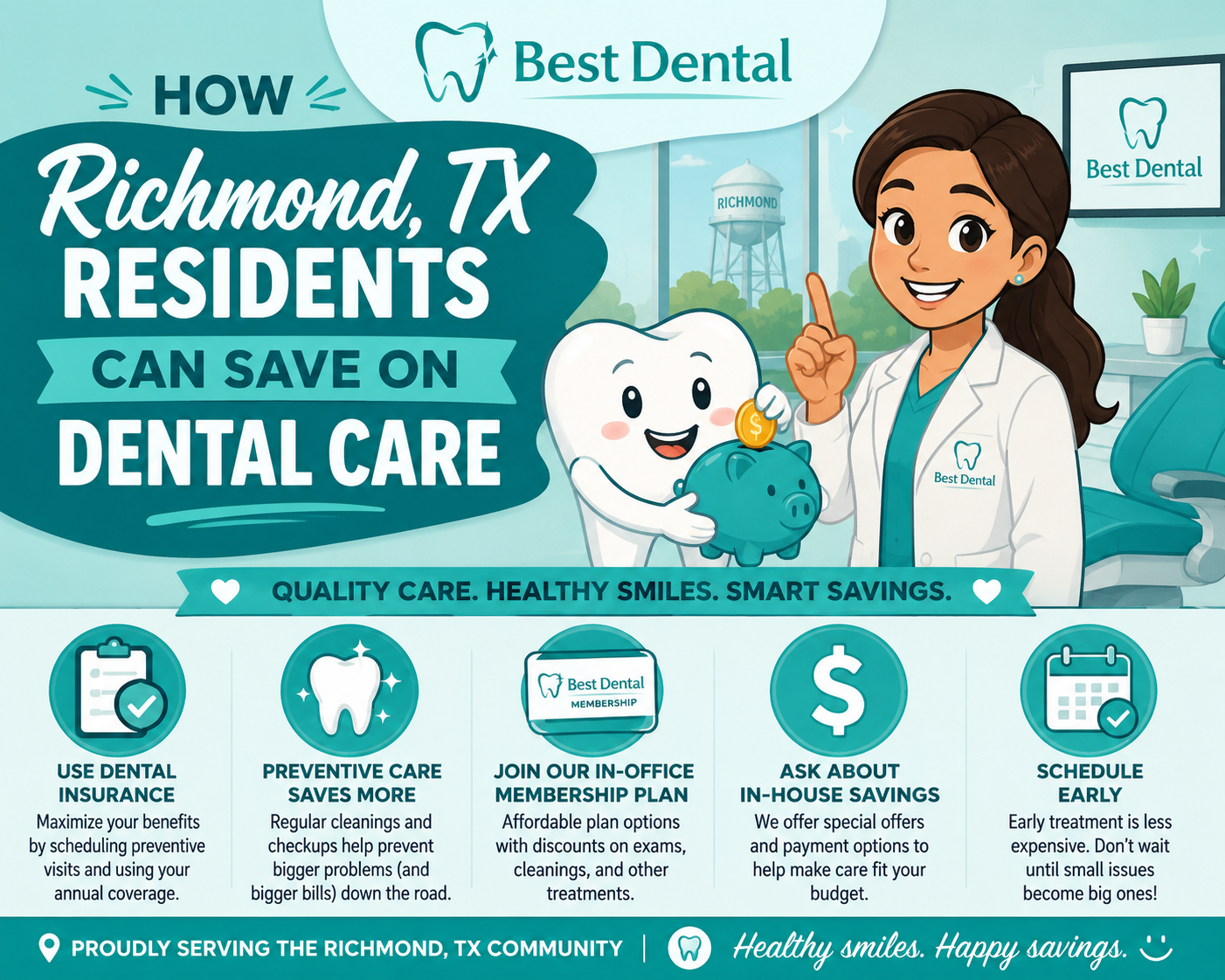
How Richmond, TX Residents Can Save Money on Dental Care
Dental care doesn't have to be expensive. For Richmond residents, the right combination of in-network PPO benefits, the Best Dental Discount Plan for cash patients, pre-tax FSA/HSA dollars, and preventive care timing can save thousands of dollars per year compared to typical Houston metro practice pricing. This guide covers every practical lever available to Richmond patients, with specific numbers and the math behind each strategy.
What's in This Guide
Twelve practical strategies for lowering dental care costs in Richmond, TX.
- Why Dental Costs Vary So Much
- 8 Strategies That Actually Save
- PPO Insurance Optimization
- The Discount Plan (For Cash Patients)
- Avoiding Overtreatment
- FSA & HSA Pre-Tax Strategy
- Financing Without Hidden Penalties
- Preventive Care Math
- The Richmond Local Advantage
- Best Dental's Published Pricing
- Frequently Asked Questions
- Schedule a Visit
Why Dental Costs Vary So Much
The same procedure can cost $800 at one practice and $1,600 at another, often within 20 miles of each other. Understanding why is the first step to spending less.
Two practices in the Houston metro area can charge dramatically different fees for the same crown, the same filling, or the same dental implant. The variation isn't random and it isn't mostly about quality. It's about four specific factors that have nothing to do with what's happening to your tooth.
Geographic overhead. A dental practice in Galleria, Memorial, Medical Center, or the Heights pays significantly higher commercial real estate costs than a practice in Richmond, Rosenberg, or other Fort Bend County locations. That overhead is reflected directly in the fees. A practice paying $15,000 per month in rent has to charge more per procedure than a practice paying $4,000. The materials, the labs, the procedure techniques, and the credentials of the dentist are often identical. The overhead is the difference.
Hidden vs published pricing. Most dental practices don't publish their fees on their website. They quote prices verbally during the appointment, often after work has already started. This makes price comparison effectively impossible and gives practices flexibility to charge what the market will bear on each individual patient. Practices that publish flat-rate pricing on their website are signaling everything they will and won't do, including the upper limit of what they'll charge.
Material upcharges. Many practices advertise a "crown price" that applies only to the most basic material (often standard porcelain) and add $300 to $700 in upcharges for zirconia, all-ceramic, or other modern materials your tooth may actually need. A $900 base price can become $1,500 by the time the actual material is selected. Practices with truly flat-rate pricing charge the same fee regardless of material.
Insurance billing tactics. Some practices bill the maximum allowable fee to insurance for every procedure, knowing PPO carriers will reimburse at the contracted rate but using the inflated billed fee to set patient expectations. Other practices use written treatment plans with itemized fees and insurance estimates so the patient knows exactly what their balance will be before treatment. The second approach is more transparent and typically results in lower actual patient cost.
For Richmond residents, the practical implication is straightforward: a 15-minute drive from Galleria-area practices to a Richmond practice with published flat-rate pricing typically saves $200 to $700 per major procedure. Over a multi-year treatment plan with several crowns, fillings, or implants, that adds up to significant money.
8 Strategies That Actually Save Money
Eight strategies that consistently work for Richmond patients, and eight common mistakes that quietly drain dental savings.
Strategies That Save
- Choose a practice with published pricing. If fees are on the website, you can plan. If not, you can't.
- Stay in-network for PPO benefits. Out-of-network often costs 30 to 50 percent more for the same procedure.
- Maximize your annual benefit before year-end. Unused PPO annual maximums don't roll over.
- Enroll in the Discount Plan if you don't have insurance. $199 per year covers 2 free exams + 2 free cleanings plus member pricing.
- Get second opinions on $2,000+ treatments. A second opinion at $99 can identify overtreatment worth thousands.
- Treat dental issues early. A $150 filling today vs $950 crown plus $750 root canal in two years.
- Use FSA/HSA pre-tax dollars. A 22 percent tax bracket means $1,000 of treatment costs you $780.
- Time treatment across two plan years. Splitting major work across December/January uses two annual maximums.
Common Mistakes
- Skipping cleanings to save money short-term. Catches up as untreated decay becoming major procedures.
- Waiting until pain to schedule. Pain typically means the procedure needed has escalated significantly.
- Accepting cosmetic add-ons during routine visits. If it wasn't mentioned before, ask why it's mentioned now.
- Going out-of-network without comparing. Out-of-network PPO cost vs Discount Plan vs another in-network practice.
- Letting annual maximum expire unused. If you have $800 left in November, schedule planned treatment before December 31.
- Falling for "free exam" offers without scrutinizing. The exam is the loss-leader; the upsold treatment plan is where the cost lives.
- Not asking for written treatment plans. Verbal quotes are reset every time you walk through the door.
- Switching practices yearly chasing specials. Each new patient exam restarts the relationship; consistency at one good practice saves more.
PPO Insurance Optimization in 5 Steps
If you have a PPO dental plan through your employer or directly, these five steps maximize what your insurance actually pays for.
Verify Benefits Before Treatment
Before any procedure beyond a cleaning, ask the front desk to verify your specific plan benefits in writing. This includes your annual maximum, deductible status, coverage percentages for major vs minor services, and any waiting periods specific to your plan. Best Dental verifies your benefits with the carrier directly before scheduling so the cost estimate you receive matches what your insurance actually pays.
Know Your Annual Maximum
Most PPO dental plans have a $1,500 to $2,500 annual maximum that resets at the start of your benefit year (usually January 1). Track how much of your maximum you've used so far this year. If you have a treatment plan that exceeds the remaining benefit, the unpaid balance is your responsibility regardless of in-network status. Knowing this number lets you plan treatment timing around what's covered.
Use Preventive Benefits Fully
PPO plans typically cover preventive care at 100 percent: 2 cleanings per year and 2 comprehensive exams. These are zero out-of-pocket if you stay in-network. Skipping a cleaning to save time is leaving covered care on the table and dramatically increases the risk of larger procedures down the road. Best Dental is in-network for 7 PPO carriers, which means preventive care is fully covered for most insured Richmond patients.
Time Major Procedures Around Your Benefit Year
If you have a planned $3,000 treatment (multiple crowns, an implant, periodontal work), splitting it across two benefit years can use two annual maximums instead of one. Schedule the first phase in December (using current year's benefits) and the second phase in January (using new year's benefits). Many Richmond patients save $1,000+ on a single treatment plan by timing it this way. The strategy only works with planned treatment, not emergencies.
Get Pre-Treatment Estimates in Writing
For any procedure costing more than $500, request a written pre-treatment estimate showing the procedure code, the published fee, the insurance-estimated coverage, and your patient balance. Insurance estimates are not guarantees, but a written estimate from the practice combined with verified PPO benefits typically produces an out-of-pocket cost very close to the final number. Best Dental provides written estimates standard before any major treatment begins.
The Best Dental Discount Plan
For Richmond residents without PPO dental insurance, the in-house Discount Plan is typically the lowest-cost path to comprehensive dental care.
A significant portion of Richmond residents do not have employer-sponsored dental insurance. Retirees on Medicare (which does not cover routine dental care), self-employed contractors, gig workers, and patients between jobs all fall into this category. For these patients, paying full retail rates at most practices makes routine dental care expensive enough that many delay it indefinitely.
The Best Dental Discount Plan is designed specifically for this group. It is not insurance. It is a flat-rate annual membership that includes meaningful preventive care plus member-only pricing on all other treatments at Best Dental in Richmond.
What's included with the $199/year membership
- 2 free comprehensive exams per year. Full clinical exam including oral cancer screening, periodontal evaluation, and bite check.
- 2 free regular cleanings per year. Standard prophylaxis. (Deep cleanings for periodontal disease are NOT free; they are billed at member pricing.)
- Member pricing on all other treatments. Fillings, crowns, root canals, extractions, implants, dentures, Invisalign, IV sedation, whitening, all at the published member rate.
- No annual maximum. Unlike insurance, there is no cap on how much treatment you can receive at member pricing per year.
- No waiting periods. Coverage starts immediately on enrollment.
- No claim forms. You pay directly at the visit; no paperwork.
The pure math: two cleanings and two exams at non-member rates would be $99 x 4 = $396. The annual membership is $199. That's already $197 in covered preventive care for $199 paid, plus member pricing on every additional treatment. For a Richmond patient who only ever uses the preventive benefit, the plan pays for itself.
Where the math really compounds: when treatment is needed. A single crown saved at the member rate often saves more than the entire annual membership cost. A dental implant at $1,995 all-inclusive vs $4,500+ at non-member rates elsewhere is a savings of $2,500+ on a single procedure. For Richmond residents planning multiple procedures (a crown plus an implant, multiple fillings, etc.), the Discount Plan typically saves $500 to $2,000+ per year compared to paying out of pocket without any membership.
The Discount Plan also works particularly well for Richmond residents whose insurance has high deductibles, low annual maximums (under $1,000), or extensive waiting periods. If your insurance won't cover major work until you've been on the plan for 12 months, the Discount Plan covers you in the meantime at substantially less than non-member retail rates.
Avoiding Overtreatment (The $2,000+ Discussion)
Treatment plans presented under pressure often include procedures that aren't strictly necessary. Use this checklist when a recommendation is over $2,000.
The Overtreatment Vetting Checklist
- Always require written treatment plans before scheduling.Procedure codes, fees, insurance coverage estimates, and your patient balance. Vague verbal quotes are reset every visit.
- Ask for the most conservative option first.If a crown is recommended, ask whether a filling, inlay, or onlay could accomplish the same goal. If full-mouth reconstruction is recommended, ask which procedures are urgent vs optional.
- Get a second opinion on $2,000+ treatments.A $99 comprehensive exam at a different practice can identify whether the original recommendation is appropriate. Best Dental provides written second opinions for Richmond residents.
- Distinguish "watch" from "treat immediately."Many early lesions can be monitored at six-month intervals before any procedure is needed. Ask whether watching is an option, not just treating.
- Ask: what if we wait six months?Some procedures must be done immediately (severe pain, active infection). Others can safely be deferred. The dentist's answer tells you how urgent the recommendation actually is.
- Require intraoral camera evidence for cracked teeth.If a dentist tells you a tooth is cracked, ask to see it on the intraoral camera screen. Cracks the dentist describes verbally without visual evidence sometimes don't exist.
- Compare crowns vs more conservative alternatives.An inlay or onlay preserves more natural tooth than a full crown. Ask whether the damage actually requires full coverage.
- Question full-mouth treatment plans of 8+ procedures.Some patients legitimately need extensive work. Others are being sold an aggressive treatment plan. A second opinion clarifies which scenario applies.
- Compare quotes when two dentists recommend different scopes.If practice A says you need three crowns and practice B says you need one crown plus two fillings, the difference is not random.
- Don't let pressure to schedule same-day push you into commitments.Reputable practices accept "I need to think about this" without resistance. Any urgency tactic on non-emergency treatment is a warning sign.
When a second opinion is worth the $99 investment
- Treatment plans over $2,000. The savings if even one procedure is unnecessary easily justifies a second exam.
- Recommendations for multiple crowns at once. Crown recommendations can be appropriate or aggressive depending on context.
- "You need a deep cleaning" without periodontal probing depths. Real periodontal disease requires charting; without it the recommendation is questionable.
- Full-mouth reconstruction without prior dental issues. Patients who suddenly need extensive reconstructive work after years of routine cleanings should verify the recommendation.
- Replacing recent restorations. If a practice wants to replace crowns or fillings placed less than 5 years ago, get a second opinion on why.
FSA & HSA Pre-Tax Strategy
If you have access to an FSA or HSA through your employer, using those dollars for dental care reduces your effective cost by your marginal tax rate.
FSAs (Flexible Spending Accounts) and HSAs (Health Savings Accounts) let you pay for qualifying medical and dental expenses with pre-tax dollars. The math is simple: if you're in the 22 percent federal tax bracket and you pay $1,000 of dental work with FSA dollars, your effective cost is $780. The $220 you would have paid in federal income tax never leaves your account.
Every dental procedure qualifies under IRS rules: cleanings, exams, fillings, crowns, root canals, extractions, dental implants, dentures, Invisalign and braces, IV sedation, whitening (for medical reasons) and prescription medications related to dental treatment. The qualification rules are broad and friendly to dental care.
The key difference between FSA and HSA:
FSA vs HSA for dental savings
- FSA (Flexible Spending Account): Available through most employer benefit plans. Annual contribution limit (typically $3,200 for 2024-25). Use-it-or-lose-it rule applies: most FSAs require you to spend the year's contribution by December 31 or a short grace period after. Unused dollars are forfeited back to the employer.
- HSA (Health Savings Account): Only available if you have a qualifying high-deductible health plan. Annual contribution limit (typically $4,150 single / $8,300 family for 2024-25). Rolls over indefinitely — unused balance carries from year to year and can grow over time. HSAs can even invest contributions, making them effective long-term dental care savings vehicles.
Practical timing strategy for FSA holders: if you have unused FSA dollars in October or November, schedule the dental work you've been deferring. December is the most heavily booked month at dental practices precisely because FSA users are racing the year-end deadline. Scheduling in November typically gives you better appointment availability for the same FSA benefit.
For HSA holders, the strategy is different. Because HSA dollars don't expire, the optimal approach is often to maximize contributions, let the balance grow, and use it for unplanned major dental procedures (a root canal plus crown after a tooth cracks, an emergency extraction, a dental implant when an existing tooth fails). The pre-tax savings on a $1,995 implant or a $1,700 root canal-plus-crown combination is substantial.
Financing Without Hidden Penalties
For larger treatment plans, third-party financing spreads the cost across months without front-loading it.
For Richmond patients who need substantial dental work but can't pay it all out of pocket upfront, Best Dental partners with two third-party financing companies that specialize in dental and medical procedures: Cherry Healthcare Financing and CareCredit. Both offer payment plans based on credit approval, with terms determined by your individual application.
Cherry Healthcare Financing. Uses a soft credit pull (no impact to your credit score for the initial inquiry, only if you actually fund a plan). Application is typically approved within minutes. Terms based on credit approval. Cherry tends to be more accessible for patients with limited credit history compared to other healthcare financing options. See our dental financing guide for more on options for patients with credit challenges.
CareCredit. A long-established healthcare credit card. If you already have a CareCredit account from a previous medical or veterinary visit, you can use the existing line of credit at Best Dental. Promotional financing terms vary based on your account and the size of the charge, with longer terms typically available for larger amounts.
A strategy that doesn't require financing: splitting major treatment across two benefit years. If you have a $3,000 treatment plan in November, you can use your remaining current-year PPO benefit on phase one, then schedule phase two in January under the new year's benefit. Many Richmond patients save $1,000+ this way without needing any third-party financing at all. This only works for planned treatment that isn't an emergency.
Practical financing decisions
- Treatment under $1,000: usually best paid out of pocket, FSA/HSA, or insurance coverage without financing.
- Treatment $1,000-$3,000: splitting across two benefit years often works better than financing.
- Treatment over $3,000 with one annual maximum already used: third-party financing typically makes sense to avoid delaying needed treatment by 6+ months.
- Always read financing terms carefully: "deferred interest" promotions can become expensive if the balance isn't paid off within the promotional period. Best Dental's front desk reviews terms with patients before applying.
Preventive Care Math
Skipping preventive visits to save money short-term is the most expensive false economy in dental care.
Two cleanings per year at $99 each plus two exams per year at $99 each totals approximately $396 in baseline preventive care. For most PPO-insured Richmond patients, this is covered at 100 percent and costs $0 out of pocket. For Discount Plan members, this is included in the $199 annual membership. For cash patients without any plan, the full $396 is paid out of pocket.
Compare that to what happens when preventive care is skipped:
Year 1 of skipped cleanings: typically no visible consequences. Plaque accumulates, gingivitis develops in some patients, but no acute dental emergency yet. Savings: $396. Hidden cost: starting decay process.
Year 2 of skipped cleanings: small cavities that would have been caught at routine X-rays progress. Gingivitis may become early periodontitis. Most patients still have no acute symptoms. Savings: $792 total. Hidden cost: cavities now require composite fillings at $125-$175 each instead of being prevented at the source.
Year 3 of skipped cleanings: a previously small cavity that wasn't treated progresses to the pulp. The tooth now needs a root canal at $750-$950 plus a crown at $950 to restore. Total cost for one tooth: $1,700-$1,900. If the cleaning had caught the cavity at year 1, the total cost would have been one $150 filling. Savings from skipping: $1,188 total over three years. Cost of the resulting procedure: $1,700-$1,900 for one tooth.
Year 4-5 of skipped cleanings: if multiple teeth have decayed, untreated periodontal disease has progressed, and tooth loss has begun, treatment costs scale dramatically. Periodontal therapy at $150 per quadrant. Multiple dental implants at $1,995 each all-inclusive for lost teeth. Full-mouth reconstruction for severe cases. Total treatment cost can reach $15,000 to $40,000+ depending on extent.
The simpler way to think about this: preventive visits catch problems while they're small. A 2mm cavity is a 30-minute filling. The same cavity untreated for 18 months becomes a 90-minute root canal plus a 60-minute crown appointment. The procedure cost, the time investment, and the patient experience are all dramatically worse on the reactive side.
Schedule the preventive visit Richmond residents should be having twice a year
$99 comprehensive new patient exam with digital X-rays at Best Dental. Free for PPO-insured patients (typically 100 percent covered) and Discount Plan members. The single highest-ROI dental visit you'll make this year.
Call (281) 215-3065
Why Richmond Has a Pricing Advantage
For Richmond residents, choosing a local practice rather than driving into Houston is one of the most direct ways to lower dental costs.
Most Richmond residents who used to drive to Galleria, Memorial, or Medical Center practices have already worked out the math: a 30 to 45 minute drive into Houston for the same procedure now available at a local Richmond practice doesn't save money — it costs more, and the time has its own cost. Best Dental at 22377 Bellaire Blvd is right in Richmond, serving residents from Aliana, Long Meadow Farms, Grand Mission, Pecan Grove, Harvest Green, and the surrounding Fort Bend County area.
Lower commercial overhead. A dental practice in a Richmond office building has commercial real estate costs of approximately $3,000 to $5,000 per month for comparable square footage that would cost $12,000 to $20,000+ in Galleria, Memorial, or Heights locations. That difference gets reflected directly in fees. A practice with $4,000 in rent can charge $950 for a crown profitably; the same practice with $15,000 in rent would need to charge $1,400-$1,600 to maintain equivalent margins.
Same materials, same labs. The dental labs that fabricate crowns, bridges, dentures, and Invisalign aligners are not exclusive to Galleria practices. Most labs serve practices across the entire Houston metro, including Richmond. The porcelain, zirconia, and Invisalign trays a Richmond patient receives at Best Dental are the same products a patient at a Galleria practice would receive for two to three times the price.
Two-doctor continuity. Dr. Sonny Naderi leads implant, family, and surgical dentistry. Dr. Jasmine Naderi leads cosmetic, restorative, and orthodontic care. Both doctors are at Best Dental every day, year after year. Richmond patients see the same dentists each visit, which means treatment recommendations are based on actual longitudinal observation rather than first-impression assessments from rotating providers. Continuity reduces the likelihood of overtreatment and improves outcomes on complex cases.
Comprehensive scope in one office. Implants, crowns, root canals, extractions, Invisalign, cosmetic work, and emergency care are all done in-house at Best Dental. Richmond patients who would otherwise be referred to specialists in Houston (an endodontist for a root canal, a periodontist for gum surgery, an oral surgeon for extractions, a cosmetic dentist for veneers) get most of their treatment under one roof. Specialist referrals add their own overhead and travel time; consolidating care at one comprehensive practice saves both.
Published flat-rate pricing. Best Dental publishes the fee for every major procedure on the website. Composite fillings $125-$175. Complete implant $1,995. Crown $950. Root canal $750/$850/$950 by tooth type. Dentures $1,250. IV sedation $500. Most Richmond patients can plan their dental spending for the year based on what's published before they ever call.
How Best Dental's Richmond pricing compares to Houston metro averages
- Crown: $950 at Best Dental vs $1,200-$1,600 typical Houston metro. Savings: $250-$650 per crown.
- Root canal (molar): $950 at Best Dental vs $1,400-$1,900 typical Houston metro. Savings: $450-$950 per molar.
- Dental implant (complete, all-inclusive): $1,995 at Best Dental vs $4,000-$6,500 itemized at typical Houston metro specialist offices. Savings: $2,000-$4,500 per implant.
- Invisalign: $3,999 at Best Dental vs $4,500-$6,500 typical Houston metro. Savings: $500-$2,500 per treatment.
- Composite filling: $125-$175 at Best Dental vs $200-$350 typical Houston metro. Savings: $75-$175 per filling.
Best Dental's Published Pricing
Every major procedure has a published flat-rate fee. PPO insurance covers a percentage; the patient balance is the remainder. Discount Plan members receive member pricing on all treatments.
| Procedure | Fee | Notes |
|---|---|---|
| New Patient Consultation | $99 | Comprehensive exam with digital X-rays. Applied as credit toward treatment. Typically covered 100% by PPO preventive benefits. Free for Discount Plan members. |
| Routine Cleaning | $99 | Standard prophylaxis. Typically 100% covered by PPO preventive benefits. Free for Discount Plan members (2 per year). |
| Deep Cleaning (SRP, per quadrant) | $150 | For patients with periodontal disease. Not included free in Discount Plan; billed at member pricing. |
| Composite Filling | $125-$175 | Tiered by surfaces. Tooth-colored. PPO basic services typically 70-80% covered. |
| Dental Crown | $950 | Flat-rate, all materials. PPO major services typically 50% covered. |
| Root Canal (Anterior/Premolar/Molar) | $750/$850/$950 | Tiered by tooth type. Crown typically needed after for back teeth. |
| Tooth Extraction | $250 | Flat-rate, all extraction types including surgical. |
| Complete Dental Implant | $1,995 | All-inclusive: post, abutment, and crown as a single fee. |
| Bone Graft (when needed) | $500 | Often placed at extraction or implant site. |
| 3-Unit Dental Bridge | $2,850 | Two crowns plus pontic. Alternative to implant for some cases. |
| Invisalign Clear Aligners | $3,999 | Special pricing. Full aligner series and final retainer included. |
| In-Office Whitening | $450 | Same-day treatment. Custom take-home trays $250. |
| Porcelain Veneers | $999/tooth | Custom-fabricated, color-matched. |
| Composite Veneers | $450/tooth | Direct-placed alternative to porcelain. |
| Dentures (Complete) | $1,250 | Flat-rate per arch. |
| Denture Repair | $450 | For existing dentures that need adjustment or repair. |
| IV Sedation | $500 | Flat-rate per session. For anxious patients or complex procedures. |
| Best Dental Discount Plan | $199/year | Per member. 2 free exams + 2 free cleanings + member pricing on all other treatments. Cash patients only. |
More Richmond dental care guides
- For implant patients: See complete dental implants in Richmond, All-on-4 implants, implant crowns, and the implant FAQ.
- For PPO patients: See PPO dentist in Richmond for in-network details by carrier and how PPO verification works before your visit.
- For implant cost details: Richmond dental implant cost breakdown, implants vs bridges, budgeting for implants, and PPO insurance with implants.
- For anxious patients: Sedation dentistry options, IV sedation, and handling dental anxiety.
- For emergencies: See our broken tooth guide for Richmond residents and failed root canal guide.
Saving on Dental Care: Richmond FAQs
Saving on Dental Care in Richmond, TX: Key Takeaways
Ready to Save on Your Dental Care in Richmond, TX?
Schedule a new patient consultation at Best Dental, your local Richmond practice with published flat-rate pricing on every major procedure. $99 comprehensive exam with digital X-rays, applied as credit toward any treatment you choose to schedule. PPO insurance verified before your appointment. Discount Plan available for cash patients at $199/year/member. Office at 22377 Bellaire Blvd, Suite 400, Richmond TX 77407.