
Oral Pathology and Biopsy Near Houston
A complete guide to oral pathology screening, biopsy, and what happens when a suspicious lesion needs to be tested. What Best Dental handles in-office. When we refer. What a biopsy costs. And what your results mean.
What's in This Guide
Everything Houston patients need to know about oral pathology screening, biopsy, cost, and what happens after results come back.
- What Is Oral Pathology?
- Warning Signs to Watch For
- Common Oral Lesions Explained
- When a Biopsy Is Needed
- Types of Oral Biopsy
- What Best Dental Handles vs. Refers
- What to Expect at Your Biopsy
- Understanding Your Results
- Cost & PPO Insurance
- Houston Areas We Serve
- Frequently Asked Questions
- Key Takeaways
What Is Oral Pathology?
Oral pathology is the field of dentistry focused on identifying, diagnosing, and managing diseases and abnormal conditions of the mouth, jaws, salivary glands, and surrounding soft tissues. This includes everything from benign lesions that need monitoring to precancerous tissue changes to oral cancers that require urgent treatment.
In a general dental practice near Houston, oral pathology work is woven into routine care. Every dental exam includes a visual and tactile screening of all the soft tissue surfaces in the mouth: the lips, inner cheeks, tongue (top, sides, and underside), floor of the mouth, hard and soft palate, and the back of the throat. Most of the time, everything looks normal. Occasionally, something does not.
When a dentist near Houston finds a lesion, discoloration, swelling, or tissue change that does not fit a clear benign explanation, the next step is either watchful monitoring with a follow-up appointment or a biopsy to get a definitive diagnosis. The goal of oral pathology screening is to catch tissue changes early, when they are most treatable.
Oral cancer is among the most preventable and most treatable cancers when caught at an early stage. When caught late, outcomes change dramatically. The five-year survival rate for oral cancer found at Stage I or II is above 80 percent. For late-stage oral cancer, that number drops below 40 percent. Regular dental exams near Houston are the most effective early detection tool available.
Warning Signs That Need Professional Evaluation
Most changes in the mouth are benign. But any change that persists for more than two weeks without a clear cause deserves a professional look. Do not wait to see if it resolves on its own past that point.
White Patches (Leukoplakia)
A white patch that cannot be rubbed off and has no obvious cause. One of the most common precancerous lesions in the mouth. Requires biopsy to determine whether tissue is benign, dysplastic, or malignant.
Red Patches (Erythroplakia)
A red or red-and-white patch in the mouth. Erythroplakia carries a significantly higher risk of malignant transformation than leukoplakia and always warrants biopsy. Far less common but more concerning.
Non-Healing Sore or Ulcer
A mouth sore that has not healed within two weeks. Canker sores and minor irritation injuries heal within 7 to 10 days. Persistent ulceration requires evaluation to rule out malignancy.
Unexplained Lump or Thickening
A lump, bump, or thickening in the cheek, lip, tongue, or gum that was not there before. Can be benign (fibroma, mucocele, salivary gland swelling) or require tissue sampling to confirm.
Difficulty Swallowing or Opening Mouth
Trismus (limited mouth opening) or dysphagia (difficulty swallowing) can indicate pathology in the jaw, throat, or deeper tissues. Requires prompt evaluation.
Unexplained Numbness or Pain
Numbness in the lip, chin, or tongue without a dental cause can indicate nerve involvement from a jaw lesion or other pathology. Pain that does not correspond to visible dental disease also warrants investigation.
Unexplained Bleeding
Spontaneous bleeding from the mouth not attributable to gum disease or trauma. Any area of tissue that bleeds easily on contact or without provocation should be examined.
Color Change in Existing Tissue
Any area of the mouth that has changed color, particularly darkening, mottling, or the appearance of pigmented spots in tissue that was previously uniform, warrants clinical evaluation.
Common Oral Lesions Explained
The vast majority of lesions identified at oral pathology screening near Houston are benign. Understanding the most common findings helps patients contextualize what their dentist is telling them without jumping to worst-case conclusions.
Benign Soft Tissue Findings
Commonly benign, often no biopsy needed
- Aphthous ulcers (canker sores). Round, shallow, painful ulcers with a white or yellow base and red border. Almost always benign. Resolve within 7 to 14 days. Recurrent aphthous stomatitis is common and manageable. Biopsy is not routinely needed unless lesions are unusually large, numerous, or non-healing.
- Fibroma. A firm, smooth, dome-shaped nodule on the cheek, lip, or gum, typically caused by chronic irritation from cheek biting or denture friction. Almost always benign. Surgical removal at a flat $500 provides definitive diagnosis and permanent resolution.
- Mucocele. A soft, bluish, fluid-filled bump on the lip or cheek from a blocked or ruptured salivary gland duct. Benign. Surgical removal at a flat $500 prevents recurrence. See more about oral surgery near Houston.
- Torus palatinus / torus mandibularis. Bony growths on the palate or inner lower jaw. Normal anatomical variants. Not pathological. Usually require no treatment unless they interfere with denture placement.
- Fordyce spots. Tiny white or yellowish spots on the inner lip or cheek. Ectopic sebaceous glands. Completely benign. No treatment needed.
Lesions That Require Biopsy
Tissue sampling needed for definitive diagnosis
- Leukoplakia. White patches that cannot be attributed to a benign cause. Risk of dysplasia or malignancy depends on location, thickness, texture, and whether the patch is homogeneous or non-homogeneous. Biopsy is the only way to know.
- Erythroplakia. Red patches or mixed red-and-white patches. Carry a higher risk of malignant transformation than white patches. Always biopsied promptly.
- Persistent non-healing ulcer. Any ulcer that has not resolved after two weeks without a clear traumatic or infectious cause.
- Unexplained pigmented lesion. Dark spots or patches in the mouth that cannot be explained by normal ethnic pigmentation, medication, or other identifiable cause.
- Salivary gland swelling or mass. Firm or enlarging swelling in a salivary gland region that does not respond to antibiotic treatment. Salivary gland tumors can be benign or malignant and require tissue sampling.
Jawbone Lesions (Referred to Parkway Oral Surgery)
Best Dental refers these to Parkway Oral Surgery
- Dentigerous cysts. Cysts that develop around unerupted teeth, most often wisdom teeth. Require surgical removal and extraction of the associated tooth in an oral surgery setting.
- Keratocysts (odontogenic keratocysts). Aggressive cysts in the jawbone with high recurrence rates. Require careful surgical removal with long-term follow-up at an oral surgery center.
- Ameloblastoma and other odontogenic tumors. Benign but locally aggressive tumors that grow within the jawbone. Require specialized surgical management.
- Periapical cysts with jawbone involvement. Large cysts at root tips that have expanded significantly into bone. Best Dental refers these to Parkway Oral Surgery when surgical access to bone is required beyond routine periapical surgery.
- Other cystic or solid tumors within the jawbone. Any lesion that requires surgical entry into the mandible or maxilla beyond routine dentoalveolar procedures.
When Does a Lesion Need to Be Biopsied?
Not every finding requires immediate biopsy. The decision to biopsy versus monitor depends on the clinical appearance of the lesion, how long it has been present, whether it has changed, and the patient's overall risk profile (tobacco use, alcohol use, HPV history, and immune status all raise oral cancer risk).
The general clinical rule near Houston: any lesion that cannot be confidently explained as benign, or that persists beyond two weeks without resolving, warrants biopsy. A biopsy is the only way to get a definitive tissue diagnosis. Clinical appearance alone is not sufficient to confirm whether a lesion is benign or malignant, even for experienced clinicians.
When Best Dental recommends biopsy
- Any white or red patch that cannot be attributed to a known benign cause such as cheek bite, denture irritation, or geographic tongue
- Any non-healing ulcer persisting beyond two weeks without clear traumatic or infectious etiology
- Any persistent lump or swelling in soft tissue that does not resolve with the removal of an obvious irritant
- Any pigmented lesion that cannot be attributed to a benign cause
- Any lesion in a high-risk area: the lateral and ventral (underside) surfaces of the tongue and the floor of the mouth carry the highest rates of malignant transformation
- Any lesion in a high-risk patient: current or former heavy tobacco users, heavy alcohol users, patients with known HPV history, or patients with previous oral cancer diagnoses
- Any change in a previously documented benign lesion: growth, color change, bleeding on contact, or new ulceration in a previously stable area
Types of Oral Biopsy
The type of biopsy used depends on the size, location, and clinical appearance of the lesion. Best Dental performs all soft tissue biopsy types in-office near Houston.
Incisional Biopsy
A small representative sample of tissue is removed from a larger lesion. Used when the lesion is too large to remove in its entirety or when removing the whole lesion would require more complex surgery. The sample is sent to pathology to characterize the tissue type before planning further treatment.
Excisional Biopsy
The entire lesion is removed and sent to pathology. Used when the lesion is small enough to excise completely in one procedure. This is both diagnostic and therapeutic: the lesion is gone and the diagnosis is confirmed at the same time.
Punch Biopsy
A circular cutting instrument removes a cylindrical core of tissue from the lesion. Used for flat or slightly raised lesions on the mucosa where a small, uniform sample is sufficient. Fast and precise with minimal tissue disruption.
Brush Biopsy (Cytology)
A stiff brush is used to collect cells from the surface of a lesion for microscopic analysis. Less invasive than surgical biopsy but also less definitive. Used as an adjunctive screening tool; a positive or atypical result always prompts a definitive surgical biopsy.
What Best Dental Handles vs. When We Refer
Best Dental near Houston is equipped to evaluate, diagnose, and biopsy soft tissue lesions of the mouth in-office at a flat $500 fee. For lesions involving the jawbone, for cystic tumors requiring bone surgery, and for complex cases needing the full resources of an oral and maxillofacial surgery center, Best Dental refers patients to Parkway Oral Surgery.
This is not a limitation of what Best Dental can do for most patients. The large majority of concerning oral lesions that patients present with near Houston are soft tissue lesions that are fully handled in-office. The referral to Parkway Oral Surgery is specifically for the subset of cases that require surgical access to bone.
Best Dental vs. Parkway Oral Surgery: Clear Scope
✅ Handled In-Office at Best Dental ($500 flat)
- White patch (leukoplakia) biopsy
- Red patch (erythroplakia) biopsy
- Non-healing ulcer evaluation and biopsy
- Fibroma excision and biopsy
- Mucocele excision and biopsy
- Unexplained soft tissue lump
- Pigmented lesion biopsy
- Salivary gland soft tissue mass
- Lip, cheek, tongue, palate lesions
- Floor of mouth lesions
→ Referred to Parkway Oral Surgery
- Cystic tumors inside the jawbone
- Dentigerous cysts requiring bone access
- Keratocysts (odontogenic keratocysts)
- Ameloblastoma and odontogenic tumors
- Large periapical cysts with bone involvement
- Any lesion requiring surgical entry into the mandible or maxilla
Referrals to Parkway Oral Surgery are made promptly so there is no delay in diagnosis or treatment for complex cases.
Your Oral Biopsy Appointment at Best Dental Near Houston
A soft tissue oral biopsy at Best Dental near Houston is a straightforward in-office procedure that most patients find far less intimidating than they anticipated.
Evaluation and Consent
The lesion is examined and documented with clinical measurements and photographs. The appropriate biopsy type is selected based on the lesion's size, location, and appearance. The procedure, risks, and what the tissue will be tested for are explained before you consent. The $500 flat fee is confirmed and any applicable PPO coverage is discussed.
Local Anesthesia
The biopsy site is numbed with a local anesthetic injection. The procedure is comfortable once the area is fully anesthetized. Most patients feel only pressure during the biopsy itself. Sedation is available for anxious patients. IV sedation near Houston is $500 flat per session and can be added to the biopsy appointment on request.
Tissue Removal
The targeted tissue is removed using a scalpel, punch, or electrosurgical instrument depending on the biopsy type. For incisional biopsies, a small representative sample is taken. For excisional biopsies, the entire lesion is removed. The procedure typically takes 10 to 20 minutes once the area is numb.
Closure and Dressing
The biopsy site is closed with dissolvable sutures in most cases. No suture removal appointment is needed. Written post-operative instructions are provided before you leave. Most patients are comfortable enough to drive themselves home after a soft tissue biopsy under local anesthesia.
Tissue Submission to Pathology Laboratory
The tissue sample is placed in a fixative solution and submitted to a pathology laboratory the same day. The laboratory prepares the tissue, stains it, and examines it microscopically. A board-certified oral pathologist analyzes the slides and produces a written pathology report.
Results and Follow-Up
Pathology results return within 7 to 14 business days. Best Dental contacts you directly when results are available and schedules a follow-up appointment to review findings and discuss any next steps. If results indicate a benign finding, monitoring is arranged. If results indicate dysplasia or malignancy, expedited referral for appropriate specialist treatment is arranged immediately.
Recovery and Understanding Your Results
Recovery from a soft tissue oral biopsy near Houston is typically straightforward. Mild soreness at the biopsy site for 3 to 5 days is normal and well-managed with over-the-counter pain relievers. Dissolvable sutures fall out on their own within 7 to 14 days. Soft foods are recommended for the first 24 to 48 hours. Avoid alcohol-based mouthwashes at the biopsy site during healing.
- Bleeding that does not stop with sustained pressure
- Increasing pain or swelling after day 3 rather than improvement
- Fever over 100.4 degrees F
- Pus or unusual discharge from the biopsy site
What Your Pathology Results Mean
Understanding the pathology report
- Benign / within normal limits. The tissue is normal or shows a clearly benign condition (fibroma, mucocele, reactive lesion). No further treatment is needed beyond monitoring if the lesion has been completely removed.
- Dysplasia (mild, moderate, or severe). Abnormal cell changes that are not yet cancerous but indicate a higher-than-normal risk of future malignant transformation. Mild dysplasia is monitored closely. Moderate to severe dysplasia warrants more complete excision and closer follow-up. Severe dysplasia is treated similarly to carcinoma in situ.
- Carcinoma in situ. Cancer cells are present but confined to the surface layer. Highly treatable at this stage. Complete excision with clear margins and close follow-up is typically the plan.
- Squamous cell carcinoma. Invasive oral cancer. Requires prompt referral to an oral and maxillofacial surgeon and oncologist for staging and treatment planning. Best Dental coordinates this referral immediately upon receiving this result.
- Other specific diagnoses. Lichen planus, pemphigus, mucous membrane pemphigoid, and other mucosal conditions have specific management protocols that are discussed at your follow-up appointment.
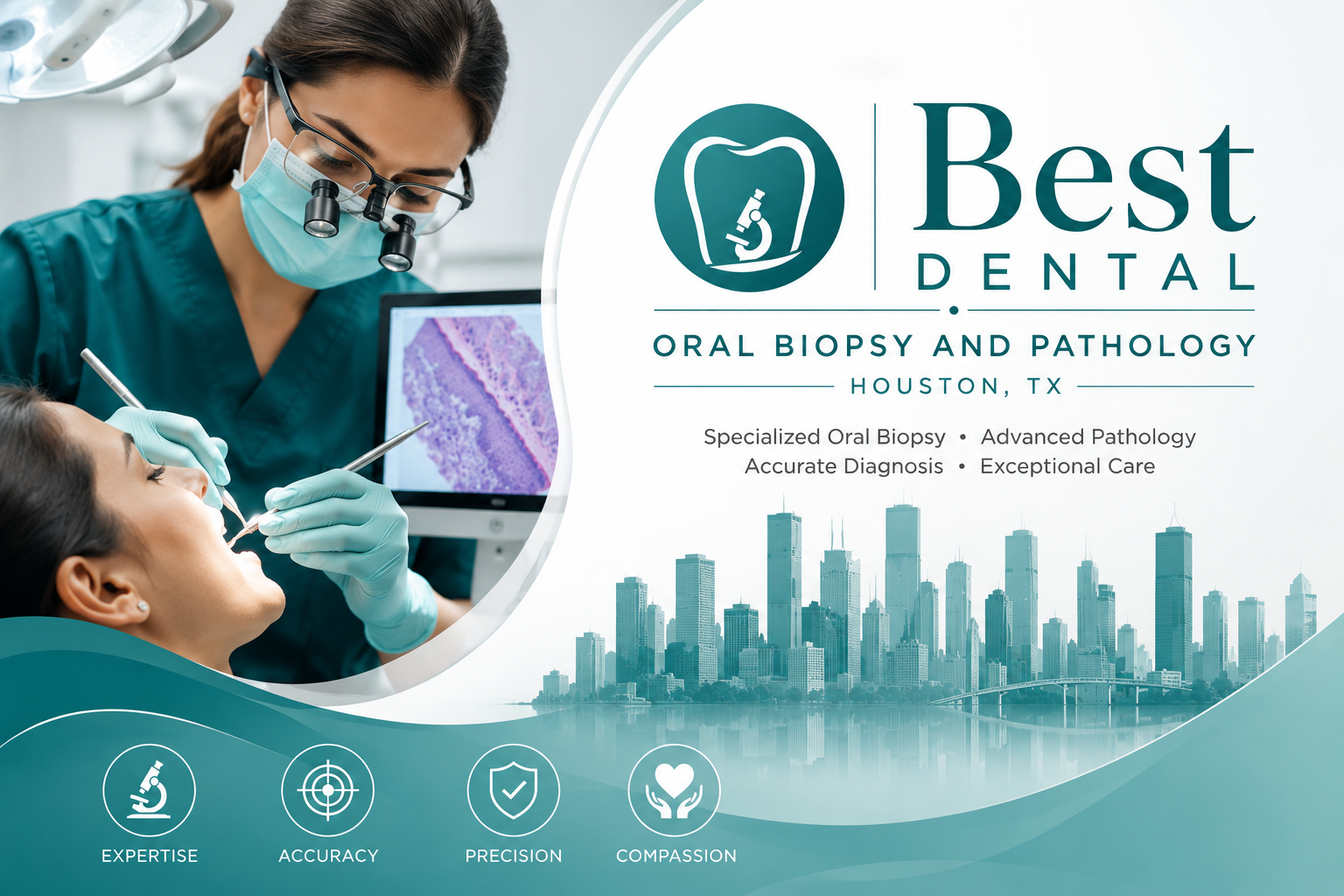
Oral Biopsy Cost Near Houston, TX
Flat fee for soft tissue oral biopsy at Best Dental near Houston. Includes the in-office excision procedure under local anesthesia and tissue submission to a pathology laboratory. No separate facility or lab fees.
| Procedure | Best Dental Fee | Notes |
|---|---|---|
| Soft Tissue Oral Biopsy | $500 flat | Incisional or excisional. Includes local anesthesia, tissue removal, and pathology submission. No additional lab fees. |
| Fibroma or Mucocele Excision with Biopsy | $500 flat | Complete excision with tissue sent to pathology for confirmation. Single appointment. |
| IV Sedation (if requested) | $500 flat | Available for anxious patients. Flat-rate per session. Requires a ride home. |
| Limited Exam (for new concern) | $89 | Focused clinical evaluation of the lesion. Separate from and not applied toward treatment. |
| Cystic Jawbone Tumors | Referred | Referred to Parkway Oral Surgery. Fees quoted by Parkway at consultation. |
PPO insurance for oral biopsy near Houston
- In-network for all 8 major PPO carriers: Delta Dental, Aetna, Cigna, BCBS Texas, Guardian, MetLife, UnitedHealthcare, and Ameritas PPO. HMO, DMO, and DHMO plans are not accepted.
- Oral biopsy is typically covered as a diagnostic or medically necessary procedure, not cosmetic. Most PPO plans cover oral biopsy at 50 to 80 percent of the fee after your deductible.
- Written cost estimate before treatment. Best Dental verifies your specific PPO coverage for oral biopsy before the appointment and provides a written patient balance estimate before you commit to anything.
- CareCredit and Cherry financing available for the patient balance after PPO coverage. Payment terms based on credit approval.
Have a lesion you want evaluated near Houston?
Call Best Dental or schedule online. Bring a note of when you first noticed it, whether it has changed, and any associated symptoms. Same-week appointments are typically available.
Call (281) 215-3065Oral Biopsy and Oral Pathology Near Houston, TX
Best Dental at 22377 Bellaire Blvd, Suite 400, Richmond TX 77407 provides oral pathology screening and soft tissue oral biopsy for patients across the Houston metro. The practice is approximately 20 to 25 minutes from Southwest Houston via US-59 or Bellaire Blvd, making it one of the most accessible in-network oral biopsy providers near Houston at a flat $500 fee.
Houston patients visiting Best Dental for oral pathology evaluation also have access to the complete range of general and restorative dental services, including dental crowns, dental implants, dental bridges, root canals, tooth extractions, dental sealants, Invisalign, braces, inlays and onlays, and dental emergency care. See the full Houston services hub for the complete list.
Related Houston services at Best Dental
- Sedation dentistry near Houston: IV sedation at $500 flat per session. Available for anxious patients at biopsy appointments, extractions, implant placement, and any in-office procedure.
- Dental bridge near Houston: $2,850 for a standard 3-unit bridge. Often needed after extraction of a tooth involved in a pathological lesion.
- Inlays and onlays near Houston: Conservative restorations for teeth with decay too large for a filling but not requiring a full crown. Common restorative follow-up after oral pathology treatment.
- Dental sealants near Houston: Protective coating applied to molar chewing surfaces. Useful for patients with a history of high decay risk identified at oral pathology screening.
- Ameritas PPO dentist near Houston: Best Dental is in-network for Ameritas PPO. Benefits verified before every appointment, including oral biopsy procedures.
- Cosmetic dentistry near Houston: Veneers, whitening, and bonding for patients whose treatment plan includes aesthetic restoration after pathology treatment is complete.
- Non-surgical dental implants near Houston: Implant options for patients who need tooth replacement following extraction of a tooth involved in a pathological lesion.
Oral Biopsy and Pathology Near Houston: FAQs
Oral Pathology and Biopsy Near Houston: Key Takeaways
Oral Pathology and Biopsy Near Houston, TX
Something in your mouth that has not gone away deserves a professional evaluation. Best Dental near Houston provides oral pathology screening at every exam and soft tissue biopsies at a flat $500 fee. In-network for all 8 major PPO carriers. 20 to 25 minutes from Southwest Houston. 22377 Bellaire Blvd, Suite 400, Richmond TX 77407.