Dental Inlays and Onlays Near Houston, TX
Inlays and onlays are custom-fabricated porcelain or composite restorations that fit precisely into a prepared tooth and last 20 to 30+ years. They preserve more natural tooth structure than crowns and dramatically outlast large fillings. Houston patients drive to Best Dental in Richmond for inlays and onlays because of locked transparent pricing, in-house digital impression capability, and the same two doctors every visit. 22377 Bellaire Blvd, Suite 400, Richmond TX, 20 to 25 minutes from West Houston via the Westpark Tollway.
Best Dental provides custom inlays and onlays for Houston patients.
If you've been told you have a cavity that's "too big for a filling but the tooth doesn't need a crown yet", an inlay or onlay is typically the right answer. Inlays fit inside the cusps of the tooth like a precision filling; onlays extend over one or more cusps for larger cases. Both are lab-fabricated or CEREC-milled from porcelain or composite and bonded permanently. They preserve more natural tooth than a crown and last 2 to 3 times longer than a large filling.
Located 20 to 25 minutes from West Houston neighborhoods. 22377 Bellaire Blvd, Suite 400, Richmond TX 77407. PPO insurance verified in writing before treatment. The Best Dental Discount Plan ($199 per year per member) provides member pricing on inlays and onlays for patients without dental insurance. Call (281) 215-3065.
In This Inlays and Onlays Guide
Filling vs Inlay vs Onlay vs Crown
Four restoration options for a damaged tooth, ranked from least to most invasive. The right answer depends entirely on how much of the tooth is still healthy. Conservative dentistry preserves as much natural tooth as possible.
Filling
Inlay
Onlay
Crown
Not sure which restoration your tooth actually needs?
The honest answer comes from a comprehensive exam with digital X-rays, not from a price list. Best Dental gives you the written treatment plan with the most conservative option that will actually last.
☎ Call (281) 215-3065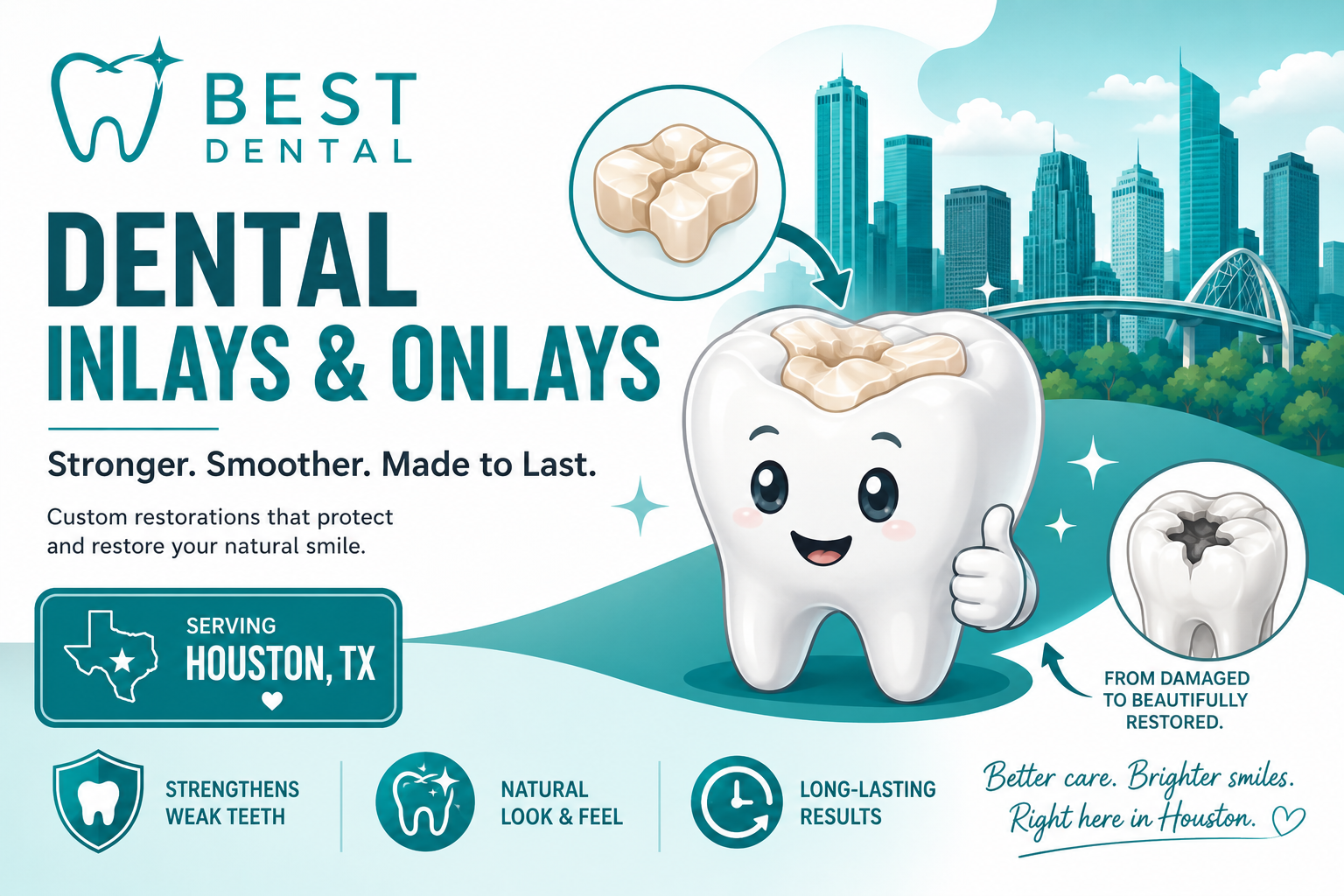
Custom porcelain restoration. A finished inlay or onlay is color-matched to your natural tooth, bonded permanently into the prepared cavity, and indistinguishable from healthy tooth structure once placed.
When an Inlay or Onlay Is the Right Choice
Inlays and onlays solve specific clinical problems that fillings and crowns can't address well. Here are the scenarios where they're typically recommended.
The Cavity Is Too Big for a Filling
When a cavity has destroyed more than half of the chewing surface, a composite filling will likely fail within 5 to 10 years and may fracture the tooth around it. An inlay or onlay restores the structure without the bulk that causes fracture.
The Tooth Is Cracked or Worn
A cracked cusp, fractured edge, or significant wear from grinding can often be repaired with an onlay rather than a full crown. The undamaged portion of the tooth is preserved while the compromised area is restored. For more severe cases involving multiple worn teeth, full-mouth reconstruction may be the appropriate approach.
Old Silver Fillings Failing
Decades-old silver amalgam fillings that have expanded, contracted, or developed gaps allowing decay to creep underneath are common in patients over 40. Replacing a failed silver filling with an inlay or onlay strengthens the tooth and eliminates the metal.
Aesthetic Concerns on Visible Teeth
Silver fillings or large composite fillings on visible teeth (premolars, especially) often look discolored or unnatural over time. Porcelain inlays and onlays match the natural tooth color exactly and maintain their appearance for decades.
The Tooth Doesn't Need a Full Crown Yet
Full crowns require grinding down significant healthy tooth structure all the way around the tooth. If the damaged area is contained, an inlay or onlay preserves the unaffected tooth structure and provides excellent long-term outcomes without crowning what doesn't need to be crowned.
You Want a Long-Term Investment
The 20 to 30+ year lifespan of a quality inlay or onlay typically beats large fillings that need replacement every 5 to 10 years. Many Houston patients choose inlays/onlays specifically for the longevity, particularly on molars that handle the bulk of chewing forces.
How Inlays and Onlays Are Made and Placed
Traditional inlays and onlays require two visits about 2 to 3 weeks apart. The fabrication process is what gives them their precision and longevity compared to direct-placed fillings.
Visit 1: Diagnosis and Tooth Preparation
Digital X-rays and clinical exam confirm the size and location of damage. The dentist explains the restoration plan and quotes the procedure in writing. After local anesthesia, the damaged tooth structure is removed and the tooth is shaped to receive the inlay or onlay. Only the damaged portion is removed; the healthy tooth structure is preserved.
Digital Impression or Scan
A precise digital impression of the prepared tooth is taken using an intraoral scanner. Some practices still use traditional putty impressions, but digital scans are more accurate, more comfortable, and faster. The scan captures the prepared tooth, neighboring teeth, and the opposing bite so the lab can fabricate a restoration that fits the bite perfectly.
Temporary Restoration Placed
A temporary restoration made of acrylic or composite is placed to protect the prepared tooth between visits. The temporary is sufficient for normal chewing on the opposite side. Avoid hard or sticky foods on the temporary side until the permanent is bonded. If a temporary comes loose, call the office immediately for re-cementation.
Lab Fabrication (2 to 3 Weeks)
The digital impression is sent to a dental lab that fabricates the porcelain or composite inlay/onlay using CAD/CAM technology. The lab matches the color to your surrounding teeth using a precise shade-matching system. Lab fabrication is what gives the restoration its strength and precision compared to fillings cured in your mouth.
Visit 2: Permanent Placement
The temporary is removed and the lab-fabricated inlay or onlay is tried on. The dentist verifies the fit, contact with adjacent teeth, color match, and bite alignment. Adjustments (if any) are made before bonding. The restoration is then permanently bonded using a strong dental adhesive. Excess is cleaned away, bite is checked one more time, and you leave with a permanent restoration.
Aftercare
Normal chewing can resume immediately after the bonding cures (within 30 minutes). Brush and floss normally; the inlay or onlay does not require special care. Minor sensitivity to cold or temperature is normal for 1 to 2 weeks. Routine 6-month cleanings and exams allow early detection of any marginal issues, which extends the lifespan of the restoration significantly.
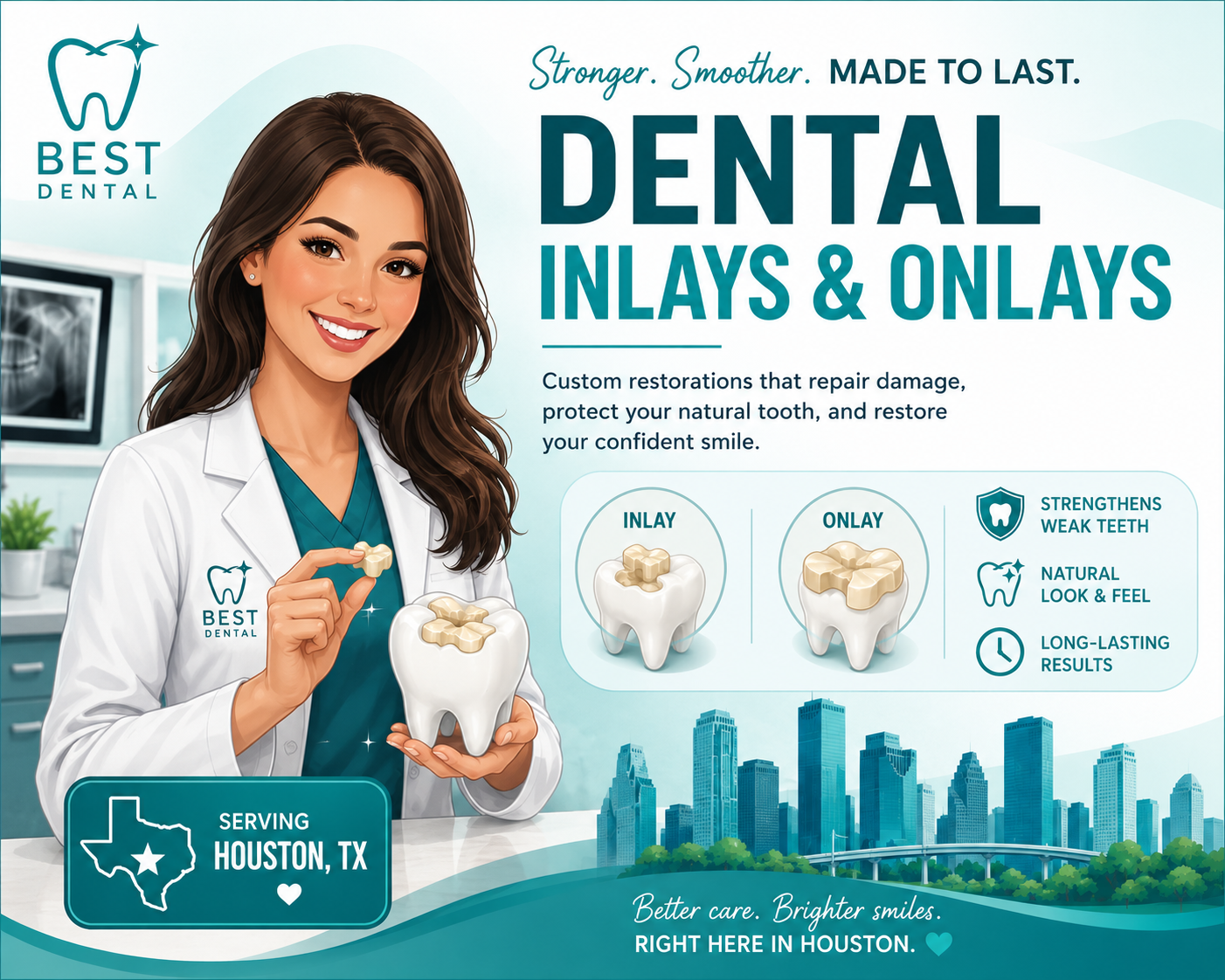
Bonded for decades. Porcelain inlays and onlays last 20 to 30 years or longer because they are lab-fabricated to precise specifications, then permanently bonded to the tooth using modern adhesives that significantly outperform direct-placed fillings.
Houston Neighborhoods That Drive to Best Dental
From most West Houston neighborhoods, Best Dental in Richmond is 20 to 25 minutes via the Westpark Tollway. For inlays and onlays specifically, the drive is well worth the locked transparent pricing and consistency of care. Below are the Houston areas we serve most often.
Energy Corridor
Westchase
Memorial / Eldridge
Alief
Briar Grove
All Houston Areas
Driving in from elsewhere in Houston?
Best Dental serves the entire West Houston area from one office at 22377 Bellaire Blvd, Suite 400, Richmond TX. Westpark Tollway access makes the drive predictable, and free parking eliminates Houston downtown hassle. Call to schedule a consultation that fits your commute.
☎ Call (281) 215-3065What Inlays and Onlays Cost at Best Dental
Published rates so Houston patients know what to expect. PPO coverage and Discount Plan membership reduce these amounts for eligible patients. Specific case pricing is provided in writing during the exam visit.
PPO benefits verified before treatment starts.
Best Dental is in-network for Delta Dental, Cigna, Aetna, Blue Cross Blue Shield, Guardian, MetLife, and United Healthcare. Most PPO plans cover inlays and onlays at 50% up to your annual maximum. Best Dental does not accept HMO, DMO, or DHMO plans. Coverage verified in writing before any work begins.
☎ Verify Benefits NowFAQs About Inlays and Onlays
The questions Houston patients ask most often when calling about inlays and onlays. Click any question to expand.
Conservative Restoration That Lasts Decades.
If you've been told your tooth needs more than a filling but not yet a full crown, an inlay or onlay is typically the right answer. Best Dental in Richmond serves Houston patients with locked transparent pricing, porcelain restorations matched to your natural tooth color, and the same two doctors every visit. Call to schedule your evaluation.