
Abscess Under a Dental Crown:
Symptoms, Treatment, and What to Do Near Houston
A crown is supposed to protect your tooth. So why does it still hurt? Here is what causes an infection under an existing crown, how to tell if that is what you have, and what treatment looks like near Houston.
You had a crown placed years ago. It did its job. Then one day the tooth starts throbbing. The gum near it swells up. It hurts to bite down. You might notice a bad taste or a small bump forming on the gum below the crowned tooth.
Your first thought might be confusion. Isn't the crown protecting the tooth? How can a crowned tooth get infected?
The answer is that a dental crown covers the outside of the tooth, but the root and the tissue inside the tooth are still very much alive. Bacteria can still reach them. When that happens, an abscess can form under the crown, just like it would on any other tooth. This is one of the more common dental emergencies we see at Best Dental, and patients come to us from across the Houston area, including Katy, Sugar Land, Rosenberg, and Missouri City, dealing with exactly this problem.
Why Does an Abscess Form Under a Crown?
A dental crown is a cap that fits over a damaged or weakened tooth. It covers the visible part above the gumline, but it does not seal the tooth off completely from bacteria forever. Several things can allow bacteria to reach the root over time.
The crown margin develops a gap
The edge where the crown meets the tooth (called the margin) can develop a microscopic gap over years of use. Crowns are designed to fit tightly, but biting forces, grinding, and normal wear can create tiny openings. Bacteria find their way in, start working on the tooth structure underneath, and work their way down toward the root.
The tooth underneath is cracked
A crown protects a tooth from further cracking, but it does not always prevent cracks from starting or spreading in the root below the gumline. A crack that reaches the root creates a direct path for bacteria to get deep into the tooth. This is called a cracked tooth syndrome abscess, and it is one of the harder cases to catch on a routine X-ray.
The old crown replaced a failing filling
Many crowns are placed over teeth that had large, old fillings. If that filling had started to fail or leak before the crown was placed, bacteria may have already been present in the tooth. The crown seals it over, but the bacterial process continues underneath. Sometimes an abscess shows up months or years after a crown is placed because the tooth was already compromised when the crown went on.
The root was never treated
If a tooth received a crown without a root canal, the nerve inside is still alive. That nerve can still get infected. Trauma, deep decay, or a cracked root can all lead to nerve death and subsequent infection, even years after the crown was placed.
Symptoms of an Abscess Under a Dental Crown
The signs of an abscess under a crown are similar to a regular tooth abscess, but patients sometimes dismiss them because they assume a crowned tooth cannot get infected. Do not ignore these symptoms.
- Throbbing pain that does not stop. This is the most common complaint. The pain may come and go at first, then become constant. It often gets worse at night or when lying down.
- Pain when biting or applying pressure to the crown. The tooth feels sensitive or sore when you chew on that side, even if the crowned tooth itself cannot feel temperature changes.
- Swelling in the gum near the crowned tooth. The gum may look puffy, red, or darker than the tissue around it. Swelling can also extend into the cheek or jaw in more advanced cases.
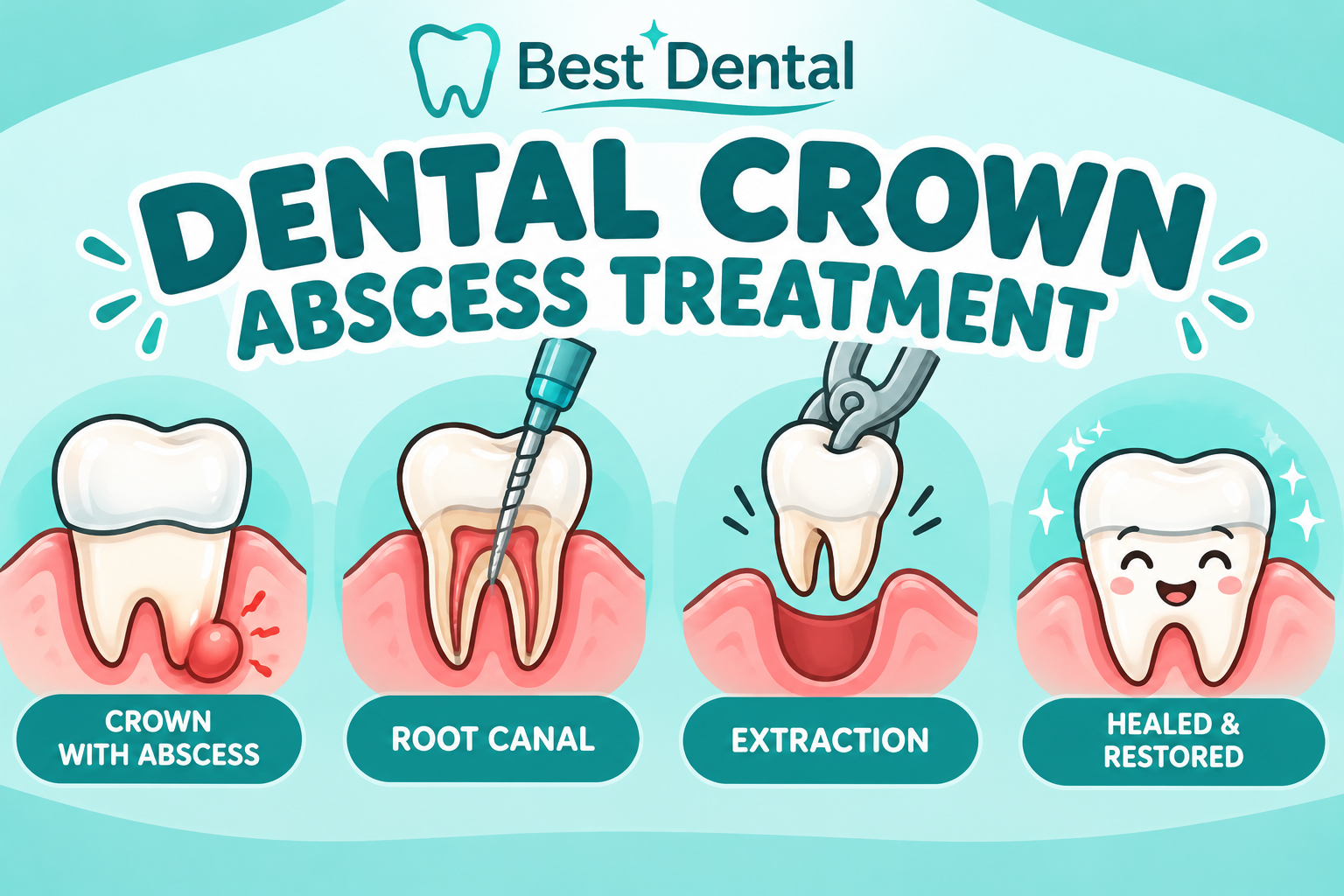
- A pimple-like bump on the gum. This is called a fistula or draining sinus tract. It is the infection trying to drain. It may ooze a bad-tasting fluid. If you see this, the abscess has already been developing for some time.
- Bad taste or odor in the mouth. Even without a visible fistula, a leaking abscess can cause a persistent bad taste that brushing does not fix.
- Pain radiating to the ear, jaw, or neck. The infection and nerve irritation can cause referred pain that feels like an earache or jaw pain on the same side.
- Loose feeling in the crowned tooth. Advanced infections can destroy bone around the root, making the tooth feel slightly mobile. This is a sign the infection has been present for a while.
Treatment Options for an Abscess Under a Crown
The right treatment depends on how serious the infection is, whether the tooth can be saved, and the condition of the existing crown. Here are the most common paths.
Root Canal Through the Existing Crown
In many cases, the dentist can drill through the existing crown to access the canals inside the tooth, clean out the infected tissue, shape and disinfect the canals, and then seal them. This saves the crown and avoids the cost of a new one. After the root canal, the access hole is filled with a composite material. The success of this approach depends on how well the existing crown fits and whether it can tolerate the drilling without cracking.
Crown Removal, Root Canal, and New Crown
When the existing crown is old, poorly fitted, cracked, or cannot safely be drilled through, it needs to come off. The root canal is performed on the bare tooth, and then a new crown is fabricated and placed. This is more expensive because it involves two procedures (root canal plus new crown), but it is often the right call for a crown that was due for replacement anyway.
Apicoectomy
If a root canal has already been done on the tooth and the infection has returned, or if the canals are not accessible through the crown, an apicoectomy may be recommended. This is a minor surgical procedure where the tip of the root (the apex) is removed along with the infected tissue. A small filling seals the end of the root from the outside. It is typically done when a retreatment root canal is not an option.
Tooth Extraction
When the tooth is too damaged to save, whether from a severe crack in the root, extensive bone loss, or repeated treatment failures, extraction is the final option. The tooth and the crown come out together. From there, a dental implant is the best long-term replacement. An implant near Houston at Best Dental is $1,995 complete, covering the post, abutment, and new crown. See our Houston tooth extraction page for extraction details.
Antibiotics (Always Alongside Treatment, Never Instead)
Antibiotics reduce the bacterial load and control spreading, but they do not get into the tooth itself. They cannot clear an infection that is locked inside a root canal. This is why antibiotics prescribed without dental treatment only give temporary relief. The infection comes back as soon as antibiotics stop. Antibiotics are a bridge to dental treatment, not a substitute for it.
What Does Treatment Cost Near Houston?
Here is a general breakdown of what to expect at Best Dental in Richmond, which serves patients from across the Houston area. All fees are confirmed in writing at your consultation before treatment begins.
| Treatment | Approximate Cost | Notes |
|---|---|---|
| Root Canal (front tooth, 1 canal) | ~$700-$900 | Through existing crown when possible |
| Root Canal (molar, 3-4 canals) | ~$900-$1,400 | Molars take longer; more canals to treat |
| New Dental Crown | $950 | Needed if existing crown is removed |
| Tooth Extraction | $250 | When the tooth cannot be saved |
| Dental Implant (post + abutment + crown) | $1,995 | All-inclusive replacement after extraction |
| Limited Exam + X-ray | $89 | Focused exam to diagnose the problem |
We accept 8 PPO dental plans: Delta Dental, Aetna, Cigna, MetLife, Guardian, Blue Cross Blue Shield, Ameritas PPO, and United Healthcare PPO. Benefits are verified before treatment so you know your out-of-pocket cost upfront. Cherry and CareCredit financing are available for patients who want to spread the cost over monthly payments.
What to Expect at Your Appointment Near Houston
Here is what a typical appointment looks like when you come to Best Dental with a suspected abscess under a crown.
- X-rays of the tooth. A periapical X-ray (which shows the whole root, not just the crown) will show a dark shadow at the root tip if an abscess is present. Sometimes a 3D cone beam scan is used for better detail on complex cases.
- Exam and diagnosis. Dr. Sonny Naderi will examine the area, check the bite, probe the gum around the crown, and review the imaging. The condition of the existing crown is evaluated to determine if it can stay or needs to come off.
- Written treatment plan with fees. Before anything is done, you receive a written breakdown of the recommended treatment, the cost, and what your insurance covers if applicable.
- Same-day treatment in most cases. For a straightforward abscess, the root canal procedure or drainage can begin the same day. Antibiotics may be prescribed to start controlling the infection immediately.
- Sedation if needed. If you are anxious about the procedure, nitrous oxide or oral sedation near Houston is available. IV sedation is also an option for more complex cases.
How to Prevent an Abscess Under a Crown
Not every abscess under a crown is preventable, but the risk goes down significantly with the right habits and regular monitoring.
- Keep regular cleaning appointments. At every visit, we check the margins of your crowns with an explorer and take periodic X-rays to catch leakage or bone changes before an abscess develops.
- Floss around crowned teeth daily. The margin between the crown and gum is a common spot for bacteria to accumulate. Flossing breaks up that biofilm before it starts working its way under the crown.
- Do not ignore sensitivity under a crown. Cold sensitivity under a crowned tooth that has lasted more than a few weeks is a sign the nerve may be irritated. Catching it early, before it becomes an abscess, can mean a simpler treatment.
- Wear a night guard if you grind. Grinding puts significant force on crowned teeth and can cause microfractures in the root or loosen the cement seal at the margin. A night guard reduces that force substantially.
- Replace old crowns at the right time. Crowns typically last 10 to 15 years. An aging crown with a failing margin is a higher infection risk. Replacing it before it fails is almost always less expensive than treating an abscess from a failed one.
Getting Treated for a Crown Abscess Near Houston, TX
Best Dental is at 22377 Bellaire Blvd, Suite 400, Richmond, TX 77407, about 25 to 35 minutes from most parts of Houston and significantly closer for patients in Katy, Sugar Land, Missouri City, and Stafford.
- From Sugar Land: about 15 to 20 minutes via US-59/I-69 West or Hwy 6
- From Missouri City: about 20 minutes via Hwy 6 West
- From Katy: about 15 to 20 minutes via Grand Parkway (TX-99)
- From Stafford: about 20 minutes via US-59 West
- From the Houston Energy Corridor: about 25 to 30 minutes via I-10 West to Grand Pkwy South
- From southwest Houston (Westheimer, Alief): about 25 to 30 minutes via Westheimer West
Free parking is available on site. We schedule same-week appointments for new patients presenting with dental pain. Call (281) 215-3065 or use our online booking link below.
Tooth Hurting Under a Crown?
Same-week appointments available for patients near Houston. Dr. Sonny Naderi examines the tooth, reviews imaging, and gives you a written treatment plan the same day. Best Dental - 22377 Bellaire Blvd, Suite 400, Richmond TX 77407.
Frequently Asked Questions
Related Articles
Serving Houston, Sugar Land, Katy, Missouri City, Stafford, Rosenberg & surrounding areas