Dental Bridges FAQ
Every question Richmond patients ask about dental bridges, answered by Dr. Jasmine Naderi and Dr. Sonny Naderi. Cost, the procedure step by step, longevity, daily care, and how bridges compare to implants and dentures.
Browse by Topic
Jump straight to the questions on your mind.
3-Unit Dental Bridge, All-Inclusive
Two abutment crowns and one pontic tooth between them, replacing a single missing tooth. Includes all appointments, impressions, the temporary bridge, and permanent placement. Typical Houston-area pricing for the same 3-unit bridge: $3,500 to $5,500. Larger bridges (4-unit, 5-unit) are quoted separately based on size.
Affordable Dental Bridges Near Me in Richmond, TX
Richmond patients searching for affordable dental bridges near them typically find Best Dental offers the lowest all-inclusive 3-unit bridge pricing in the Fort Bend County area, with porcelain materials and lab work matched to the higher-priced practices.
Flat Pricing, No Surprises
$2,850 covers a complete 3-unit bridge. Every appointment, the temporary, the impressions, and the final cementation. See full pricing here.
Two-Visit Turnaround
Most bridges are designed, fabricated, and permanently cemented in about 2 to 3 weeks. Faster than the 3 to 6 month timeline of an implant, which matters when you need to chew normally again now.
Financing & PPO Insurance
We accept most major PPO plans (bridges are typically a major-services benefit) and offer financing through CareCredit and Cherry. Free benefits verification before treatment. Learn more on our financing page.
Frequently Asked Questions
Organized by topic. If your question is not covered, call us at (281) 215-3065 and our team will answer it directly.
Bridge Basics
What a bridge actually is and what it does.
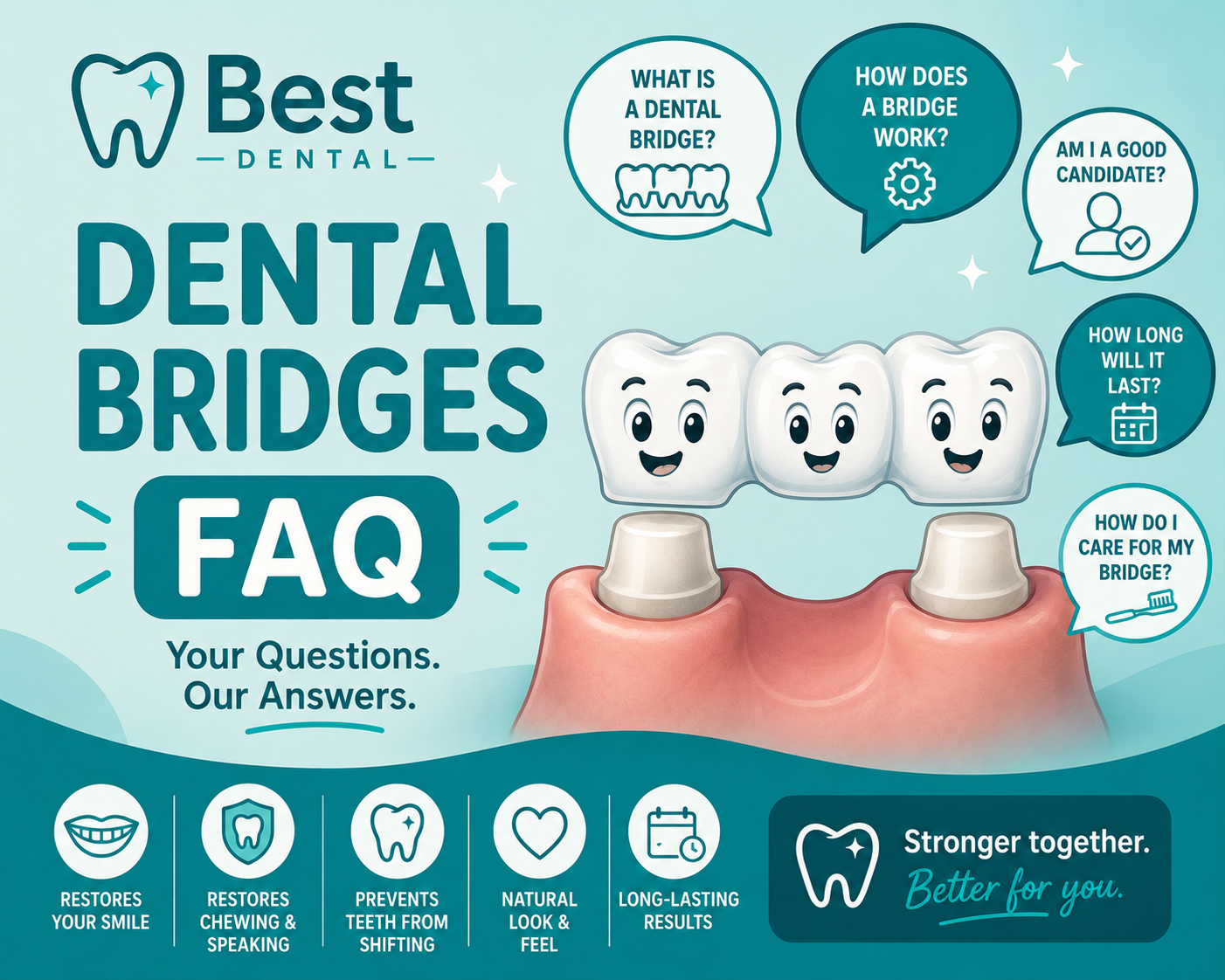
A dental bridge is a fixed (non-removable) tooth replacement that literally bridges the gap left by one or more missing teeth. A standard 3-unit bridge has three connected porcelain pieces:
Two abutment crowns on either end. These cement onto the natural teeth on each side of the gap, which are filed down slightly to receive them. These natural teeth are called the "abutment teeth."
One pontic in the middle. This is the false tooth that fills the gap. It rests against the gum where the missing tooth used to be.
All three pieces are fused into a single porcelain unit that is permanently cemented in place. Unlike dentures, a bridge cannot be removed. It restores chewing function, prevents the surrounding teeth from drifting into the empty space, and preserves your facial structure. Learn more on our main dental bridges page.
The most common reasons:
1. Restore chewing function. Even one missing back tooth forces the others to compensate, which can lead to uneven wear and jaw strain.
2. Prevent teeth from shifting. When a tooth is missing, the neighboring teeth slowly tip into the gap and the opposing tooth (the one that used to bite against it) drifts down or up. This creates new gaps, bite problems, and increased decay risk.
3. Preserve facial structure. Multiple missing teeth without replacement can cause the cheeks and lips to sink inward over time.
4. Speech. Missing front teeth especially can affect pronunciation of certain sounds.
5. Smile aesthetics. A visible gap, particularly in the front, can affect confidence.
Three things happen, all of them slow but progressive:
Adjacent teeth tip into the gap. Within 6 to 12 months you can usually see measurable drift. Over years this creates crowding and angled teeth that are harder to clean.
The opposing tooth supererupts. Teeth are constantly being pushed up by the bone underneath. Without an opposing tooth to push back, the opposing tooth drifts out of its socket toward the empty space. Eventually the root can become exposed.
The underlying jawbone resorbs. The bone where the root used to be loses its stimulus and gradually shrinks. This is the same mechanism that leads to the sunken-face appearance in long-term denture wearers.
None of this is reversible without significant intervention later, so replacing a missing tooth promptly is almost always the cheaper and easier long-term path.
Types of Bridges
The four main bridge designs and when each is used.
Traditional fixed bridge: the most common design. Two crowns on the abutment teeth with one or more pontics between them. Used when there are healthy natural teeth on both sides of the gap. This is what most patients mean when they say "dental bridge."
Cantilever bridge: a bridge supported by an abutment tooth on only ONE side, because there is no usable tooth on the other side. Less common because the unsupported end takes more bite force. Usually limited to areas with lower chewing load, like front teeth.
Maryland (resin-bonded) bridge: a pontic with thin metal or porcelain "wings" that bond to the backs of the adjacent teeth without filing them down. Much more conservative since the abutment teeth are not crowned. The trade-off is lower bond strength, so Maryland bridges are most often used for front teeth where bite force is lower. Common for patients who lost a front tooth from trauma and want to preserve the neighboring teeth.
Implant-supported bridge: uses two dental implants (not natural teeth) as the abutments. The strongest option, prevents bone loss, and does not require modifying any natural teeth. Higher upfront cost and longer timeline because the implants must integrate with bone first.
We recommend the right type at the consultation based on which teeth are missing, the condition of the adjacent teeth, and your goals.
All-porcelain (or all-ceramic) bridges: the most natural-looking option, with translucency that closely matches enamel. Best for front teeth where appearance matters most. Modern ceramic materials like zirconia are very strong.
Porcelain-fused-to-metal (PFM) bridges: a metal substructure (usually a gold alloy or non-precious alloy) with porcelain layered on top. Extremely durable, slightly less translucent than all-porcelain. A workhorse choice for back teeth where strength matters more than perfect translucency.
Zirconia bridges: milled from a solid block of zirconia ceramic. Combine the strength of metal-supported bridges with the aesthetics of all-porcelain. Increasingly common for both front and back bridges.
At Best Dental we use materials matched to the location and bite force of each case, and we discuss the choice with you before fabrication.
The Procedure
What happens at each visit, start to finish.
A traditional bridge is a two-visit process spread over 2 to 3 weeks.
Visit 1 (90 to 120 minutes):
• The area is numbed with local anesthesia
• The abutment teeth (the natural teeth on either side of the gap) are filed down to make room for the crowns. This is the same preparation as a single crown, done on both teeth
• A detailed impression or digital scan is taken of the prepared teeth and the opposing arch
• Shade is selected to match your natural teeth
• A temporary bridge is fabricated chairside and cemented in place to protect the prepared teeth and let you chew normally while the lab makes the permanent bridge
Lab time: 2 to 3 weeks for the permanent bridge to be fabricated.
Visit 2 (45 to 60 minutes):
• The temporary bridge is removed
• The permanent bridge is checked for fit, color, contour, and bite
• Any minor adjustments are made
• The bridge is permanently cemented in place
Some patients come back for a short follow-up a week later to verify everything is settling correctly.
The procedure itself is not painful. Both visits are done under local anesthesia, so during preparation you feel only pressure and vibration. After the first visit, as the anesthesia wears off, you may notice mild sensitivity or soreness in the prepared teeth for 2 to 4 days. Over-the-counter ibuprofen handles it for most patients.
The temporary bridge may feel slightly different in shape or texture from your natural teeth, but it should not hurt. If your temporary feels too high when you bite down, call us immediately, even a small high spot can cause significant soreness within hours.
Once the permanent bridge is cemented, most patients describe it as comfortable within a few days. Mild temperature sensitivity in the first week is normal and usually resolves on its own.
The abutment teeth must be healthy enough to support a bridge for many years. If they have:
Decay: the cavity is removed and the tooth is built up before crowning. Quoted separately.
An infected nerve: a root canal is done first. Quoted separately.
Significant gum disease: the gum disease is treated and stabilized before any bridgework. Quoted separately.
We will only place a bridge on teeth strong enough to carry it, because a bridge supported by failing teeth will fail with them.
Cost & Insurance
Real numbers, with the cash-vs-insurance picture spelled out.
$2,850 for a traditional 3-unit bridge, all-inclusive. This is the most common configuration: two abutment crowns plus one pontic, replacing a single missing tooth.
What is included:
• Both preparation appointments
• Impressions or digital scans
• Lab fabrication of the permanent bridge
• Temporary bridge
• Final cementation
• Follow-up adjustment visits
Larger bridges are quoted separately:
• 4-unit bridge (replacing 2 adjacent teeth): higher than $2,850
• 5-unit and 6-unit bridges (longer spans): priced by case
Typical Houston-area pricing for the same 3-unit bridge runs $3,500 to $5,500. See the full pricing page.
Possible additional costs (quoted separately if needed): root canal on an abutment tooth ($750 to $950 depending on tooth), buildup if an abutment is significantly decayed, extraction of the failing tooth being replaced ($250), or treatment of gum disease.
Most PPO dental plans cover bridges as a major restorative procedure, typically at 50% after deductible, up to the annual maximum (commonly $1,000 to $2,500). Coverage applies when the bridge is medically necessary, meaning the missing tooth affects chewing or speech.
Watch for these plan details:
• Annual maximum cap: bridges often hit the annual max for that year, leaving the remainder out-of-pocket
• Waiting periods: some plans require 6 to 12 months of coverage before major-service benefits activate
• Missing tooth clause: a handful of plans exclude bridges for teeth that were missing before the policy started
• Pre-authorization: we submit X-rays and treatment notes before starting so you know in advance what your share will be
The $2,850 price is our cash (self-pay) rate. Your out-of-pocket cost with insurance depends on your specific PPO plan. We verify PPO benefits for free before treatment begins.
For most patients, yes. The "do nothing" path looks cheaper in the short term but leads to real costs down the road:
Adjacent teeth shift, sometimes requiring orthodontics to put back in place ($3,500 to $5,500 for braces).
Opposing tooth supererupts, often requiring its own restorative work or even extraction.
Bone loss makes future tooth replacement harder, sometimes pushing you toward bone grafting ($500 to $1,000+) before an implant becomes feasible.
Replacing a missing tooth promptly with a bridge (or an implant) is almost always the cheaper long-term option, even though it does not feel that way at the moment of decision.
Living with a Bridge
Eating, appearance, and what daily life feels like.
Yes. Modern porcelain bridges, especially all-ceramic and zirconia, mimic the translucency of natural enamel closely enough that most people will not be able to tell which tooth is the pontic. We match the shade to your existing teeth (or to your preferred shade if you plan to whiten), and the gumline contour is sculpted to look natural where the pontic meets the gum.
Front-tooth bridges require the most aesthetic finesse, and we use all-ceramic or zirconia materials for these. We confirm the appearance with you at the try-in stage before permanent cementation, so you have a chance to request adjustments.
Some patients choose to whiten their natural teeth before getting the bridge, so the porcelain can be matched to the brighter shade. Whitening will not change the color of the bridge itself.
Yes, with a few common-sense limits.
First few days after placement: stick to soft foods while the cement fully sets and your bite adjusts.
After that, normal diet for the most part. The two foods to be careful with for the life of the bridge:
• Very hard items like ice, hard candy, or unpopped popcorn kernels. These can chip the porcelain
• Very sticky items like caramel or taffy. These can occasionally pull a temporarily cemented bridge loose (the permanent cement is more resistant, but caution helps)
Chew on both sides of your mouth to distribute force evenly. Cut hard foods like raw apples into smaller pieces rather than biting straight in with the front teeth. After a couple of weeks, most patients report the bridge feels so natural they forget it is there.
Traditional bridges: no. The pontic rests on top of the gum and does not stimulate the underlying bone the way a natural tooth root does. So the bone in the area of the missing tooth continues to resorb gradually over years, just as it would without a bridge. After 10 to 20 years this can become visible in the contour of the gum under the pontic, sometimes requiring the bridge to be remade with a longer pontic.
Implant-supported bridges: yes. Because the implant posts transmit chewing force into the jawbone the same way natural roots do, the bone is stimulated and preserved.
If preserving bone is a high priority (especially for a younger patient with decades of life ahead), we may recommend an implant or implant-supported bridge instead of a traditional bridge for that reason alone.
Care & Cleaning
Daily hygiene around a bridge is slightly different from natural teeth.
This is the single most important skill for making a bridge last. Because the pontic is connected to the abutment crowns on both sides, you cannot floss between them the normal way. Plaque trapped under the pontic causes gum inflammation and is the leading reason abutment teeth develop decay under their crowns.
Three tools that work:
1. Floss threader: a small plastic loop (like a needle threader) that you use to pull regular floss under the pontic. Once threaded, slide the floss back and forth along the gum and the underside of the pontic. Do this once daily.
2. Superfloss: floss with a stiff end that threads under the bridge without a separate threader. Faster than the threader method.
3. Water flosser (oral irrigator): excellent for flushing food and plaque from under the pontic. Pair it with regular flossing rather than substituting for it.
We will show you exactly how to do this at the cementation visit.
Brushing is essentially the same as brushing natural teeth: twice daily with a soft-bristle toothbrush and fluoride toothpaste, 2 minutes per session. Pay extra attention to the gumline where the bridge meets the gum, and angle the bristles toward the gumline at 45 degrees to clean under the gum margin. Electric toothbrushes are excellent around bridges. Continue regular 6-month cleanings at Best Dental, the hygienist uses specific techniques designed to clean around fixed restorations.
If you grind or clench your teeth at night (bruxism), absolutely yes. Grinding generates many times the force of normal chewing, which can chip the porcelain, crack the bridge, or fatigue the cement bond. A custom nightguard distributes the force and is the single biggest factor in extending a bridge from 10 years to 20+ years for a grinder. We check for grinding signs (worn enamel, scalloped tongue edges, jaw soreness) at your consultation.
Longevity & Repair
How long bridges last and what to do if something goes wrong.
Traditional bridges: 10 to 15 years on average, with many lasting 20+ years.
Implant-supported bridges: 20+ years, often longer (the implant posts themselves can last a lifetime; the crown/bridge superstructure may need replacement at 15 to 20 years).
The factors that most affect bridge lifespan:
• Oral hygiene under the pontic. The #1 reason traditional bridges fail is decay developing in an abutment tooth under its crown, usually because plaque accumulated under the pontic and gradually worked its way under the crown margin
• Grinding habits. Without a nightguard, grinders cut bridge lifespan roughly in half
• Material choice. PFM and zirconia are more fracture-resistant than all-ceramic
• Health of abutment teeth at the start. A bridge anchored to two very healthy teeth lasts longer than one anchored to teeth with extensive prior restorations
Call us immediately for an emergency visit. Do NOT try to re-cement it yourself with hardware-store glue or over-the-counter dental adhesive, both can interfere with proper re-cementation and one can damage the abutment teeth.
If the bridge has come out entirely: gently clean it and your remaining teeth. If it slips back into place comfortably, you can use temporary dental cement from a pharmacy to hold it for 24 to 48 hours until your appointment. If it does not slip into place easily, do not force it. Put it in a small container and bring it in.
Why bridges come loose:
• Cement breakdown over time (often fixable with re-cementation if the bridge and teeth are otherwise healthy)
• Decay in an abutment tooth that hollowed out the crown's seat (the tooth needs treatment before the bridge can be re-seated, or a new bridge may be needed)
• A failing abutment tooth (sometimes requires switching to an implant solution)
It depends on what failed.
Small porcelain chip on the pontic or crown: can sometimes be polished smooth or repaired with composite bonding chairside.
Significant porcelain fracture: usually requires replacing the bridge.
Cement washout (the bridge is loose but intact): often re-cementable, no replacement needed.
Decay under an abutment crown: the decay must be treated, and depending on extent, the bridge can sometimes be saved or may need to be remade.
Failed abutment tooth: if one of the supporting natural teeth fails, the bridge cannot be saved as-is. Options include a longer bridge with a different abutment, switching to an implant-supported bridge, or transitioning to implants.
Bridges vs Implants & Dentures
How bridges compare to the other tooth replacement options.
It depends on your specific case, but here is the honest comparison.
Implants are usually better when:
• The adjacent teeth are healthy and you want to keep them untouched. A bridge requires filing down both adjacent teeth even if they are perfect
• You want the longest-lasting option (implants can last a lifetime; bridges average 10 to 15 years)
• Preserving jawbone matters (implants prevent bone loss, traditional bridges do not)
• You are young and want a single permanent solution rather than a bridge that will likely need replacement in your 60s or 70s
Bridges are often better when:
• The adjacent teeth already have large fillings or need crowns anyway, so crowning them as bridge abutments is "free" in the sense that they needed the work
• You want a faster solution (2 to 3 weeks vs 3 to 6 months for an implant)
• You are not a good surgical candidate (uncontrolled diabetes, heavy smoking, certain medications)
• The bone in the area has resorbed too much for an implant without major grafting
At Best Dental, an implant is $1,995 all-inclusive (post, abutment, and crown), and a 3-unit bridge is $2,850. The implant is often the better long-term value when feasible, but bridges remain the right call in plenty of specific cases.
Bridges win on stability and comfort. A bridge is permanently cemented in place. A partial denture is removable, sits on a metal or acrylic framework, clips onto remaining teeth, and is taken out at night for cleaning.
Partial dentures win on cost and conservatism. A partial is less expensive than a bridge and does not require modifying the adjacent teeth at all.
Bridges win on feel. Most patients describe a bridge as feeling like natural teeth within a week or two. A partial always feels like an appliance.
For replacing one or two teeth in a healthy mouth, a bridge or implant almost always provides a better long-term result than a partial denture. Partials are most often used when multiple non-adjacent teeth are missing, when finances rule out bridges/implants, or as a transitional solution while patients save for implants.
📋 Key Takeaways
Ready to Close the Gap?
Schedule a consultation with Dr. Jasmine Naderi or Dr. Sonny Naderi at Best Dental in Richmond, TX. We will evaluate the missing tooth area, check the health of potential abutment teeth, and walk you through whether a bridge or an implant is the better fit for your case, with a flat all-inclusive price before anything begins.